

How Maryland’s Building Energy Rules Collide With a Grid Squeeze Legislators Helped Create
Executive Summary
Maryland’s Building Energy Performance Standards (BEPS) were built to push large commercial and multifamily buildings to net-zero direct emissions by 2040. In practice, the program is landing on Maryland’s cost-of-living and cost-of-ownership crisis from two directions at once.
First, broad carve-outs — hospitals, schools, federal buildings, manufacturing, agriculture, and now all of Montgomery County — concentrate compliance cost onto a narrower set of private commercial and multifamily owners.
Second, and less discussed, the electrification BEPS requires is landing on a Maryland power grid that legislators and regulators have allowed to tighten: generation retiring faster than it’s replaced, data-center load surging region-wide, and a new electric-vehicle mandate adding demand on top.
The result is a supply-and-demand imbalance that is substantially self-inflicted by policy choices — and one that private owners, and ultimately tenants and renters, are being asked to underwrite through higher rates and higher bills.
The Rule, Briefly
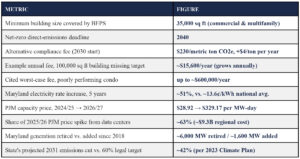
Enacted under the Climate Solutions Now Act of 2022, BEPS covers commercial and multifamily buildings of 35,000 square feet or larger. Owners must benchmark energy use annually through ENERGY STAR Portfolio Manager, verify that data by a third party every five years starting in 2026, and meet declining greenhouse-gas-intensity targets: an interim standard from 2030–2034, a tighter one from 2035–2039, and net-zero direct emissions from 2040 on.
Owners who miss a target can pay an alternative compliance fee — $230 per metric ton of excess CO2e in 2030, rising about $4/ton annually — rather than retrofit outright.
Who’s Exempt, Who Pays
The 2025 amendments (HB49) added hospitals, steam sterilization, backup generators, and federal secure facilities (SCIFs) to the exemption list, and a separate carve-out now waives Montgomery County buildings from the state program entirely. Each exemption is individually defensible — hospitals cite life-safety power needs, for instance — but collectively they shrink the covered building stock while the emissions math and the compliance cost stay fixed.
What’s left is mostly private commercial office, retail, and multifamily housing, including condominiums that often can’t pass costs to residents the way a net-lease landlord can pass costs to tenants.
“The cost of BEPS compliance would be at least $40,000 per unit” — cited estimate from a ~2,000-unit Baltimore multifamily operator, implying roughly $400/month in added rent to cover compliance.
Real-world exposure varies widely by building age and fuel type. Industry modeling puts the annual alternative compliance fee for a 100,000-square-foot multifamily building missing its 2030 target at roughly $15,600 — a number that escalates every year even if the building’s performance doesn’t change. Maryland NAIOP has cited far higher exposure, up to roughly $600,000 a year, for poorly performing large buildings. On top of the fee sits the capital cost of electrification retrofits, which the available public estimates put in the millions of dollars for a full gas-to-electric conversion of a large structure — costs with no reliable Maryland-specific per-square-foot benchmark yet published.
A Squeeze That’s Substantially Self-Inflicted
This is where the affordability story gets more complicated than a single regulation. BEPS asks owners to electrify heating and hot water — shifting demand onto the power grid — at the same moment two other policy and market forces are driving Maryland’s electricity costs up faster than almost anywhere in the country.
Rates are already outrunning the region. Maryland’s average electricity rate has climbed roughly 26% over three years and about 51% over five, to 16.83¢/kWh versus a 13.63¢ national average — higher than Pennsylvania, Virginia, or West Virginia. Residential prices alone rose about 18% between October 2024 and October 2025.
Data centers are absorbing regional capacity. Data centers are projected to triple their share of the regional grid between 2024 and 2029 and drove an estimated 63% of the 2025/26 PJM capacity-price spike — a jump from $28.92 to $269.92 per megawatt-day, then to $329.17 for 2026/27 — adding an estimated $9.3 billion in regional customer costs in a single year. Most data centers sit outside BEPS’s covered categories, and advocates worry the SCIF exemption could be stretched to cover more of them.
Generation hasn’t kept pace — by policy choice as much as market failure. Maryland has retired about 6,000 MW of generation since 2018 while adding only 1,600 MW (roughly 300 MW of in-state capacity over five years, mostly solar), leaving the state reliant on imports for about 40% of its power. Ratepayers are now covering $629 million to keep aging fossil plants online through 2029 just to cover the gap — meaning newly “electrified” buildings may be drawing marginal power that isn’t meaningfully cleaner in the near term.
A second mandate is stacking demand on the same grid. Maryland’s adoption of Advanced Clean Cars II adds electric-vehicle charging load on top of BEPS-driven building electrification — two state mandates pulling on the same constrained supply simultaneously, without a matching build-out of clean generation. PJM has proposed reforms — a separate procurement track for data centers and a plan to curtail them before residential customers in emergencies — that could eventually shift cost off ordinary ratepayers. But by PJM’s own three-year-ahead procurement cycle, those reforms can’t take effect before 2030 at the earliest, squarely overlapping BEPS’s first compliance window. Maryland’s People’s Counsel also warns that if forecasted data-center growth doesn’t materialize as planned in some zones, existing customers could still absorb over $500 million in stranded costs.
The Affordability Math
Layer these together and the cost-of-ownership problem stops being additive and starts compounding: BEPS retrofit capital, BEPS compliance fees, and electricity rates rising for reasons largely outside any one owner’s control or the rule’s control. For multifamily and condo owners in particular, that cost has limited places to go — special assessments, deferred maintenance, or rent increases — at the exact moment Maryland is separately trying to protect housing affordability. For commercial owners, lenders and appraisers are beginning to treat unresolved BEPS exposure as a future capital call, which can weigh on financing terms and valuation independent of whether a retrofit is ever built.
Uncertainty on Top of Cost
A federal lawsuit (Maryland Building Industry Association, BOMA Greater Baltimore, NAIOP Maryland, Washington Gas, and residential associations) argues BEPS is preempted by the federal Energy Policy and Conservation Act; some attorneys view the challenge as strong. Meanwhile the state’s own 2023 Climate Pollution Reduction Plan projects only about 42% emissions reduction by 2031, well short of the 60% required by law — and separate rollbacks to the EmPOWER efficiency program and proposed building-code changes may push that further off track.
For owners, the practical effect is a rule that’s expensive to comply with, legally contested, and not yet proven to hit its own statewide target — a hard combination to underwrite around.
Bottom Line for Owners and Investors
• Model BEPS exposure building-by-building now — fuel type, size, and current EUI drive cost far more than any statewide average.
• Treat electricity rate risk as part of the compliance case, not separate from it: an electrification retrofit priced against today’s kWh rate may understate true payback.
• Watch the PJM data-center reforms and the EPCA lawsuit — both could materially change the cost and timeline calculus before the 2030 compliance window opens.
• Factor compliance and rate uncertainty into underwriting and lease structuring today, particularly for multifamily and condo assets with limited ability to pass costs through.
By the Numbers
Sources
- Maryland Building Energy Performance Standards — Maryland Dept. of Energy
- COMAR 26.28 Building Energy Performance Standards Fact Sheet — MDE (July 2024)
- Maryland BEPS: Requirements, Deadlines, and Recommendations — Swinerton (2026)
- Recent Legislative Amendments Could Impact Compliance Deadline — Beveridge & Diamond
- Maryland’s building emissions rules got ‘trimmed’ this session — Maryland Matters
- Citizens and Businesses Join Suing Maryland to Halt BEPS — Green Building Law Update
- Maryland’s BEPS: A Roadmap for Multifamily Owners — Yield PRO (2026)
- Maryland Energy Standards Will Put Businesses Out of Business — SBJ
- Maryland Faces Criticism Over Scaled-Back Energy Efficiency Program — Inside Climate News
- Why Maryland’s Electric Rates Are Rising Faster Than the National Average — Gordon Feinblatt
- As Data Centers Multiply, Maryland’s Power Grid Struggles to Keep Up — Capital News Service Maryland
- Projected Data Center Growth Spurs PJM Capacity Prices by Factor of 10 — IEEFA
- PJM Looks to Implement Key Data Center Regulations — WYPR
- Governor Moore Announces Maryland Adoption of the Advanced Clean Cars II Rule
This briefing synthesizes public reporting, regulatory filings, and industry commentary as of September 2026 for general informational purposes. It is not legal, financial, or investment advice; figures cited from advocacy or industry sources reflect their published positions and should be verified against building-specific analysis before use in underwriting or public communications.
Leave A Comment