
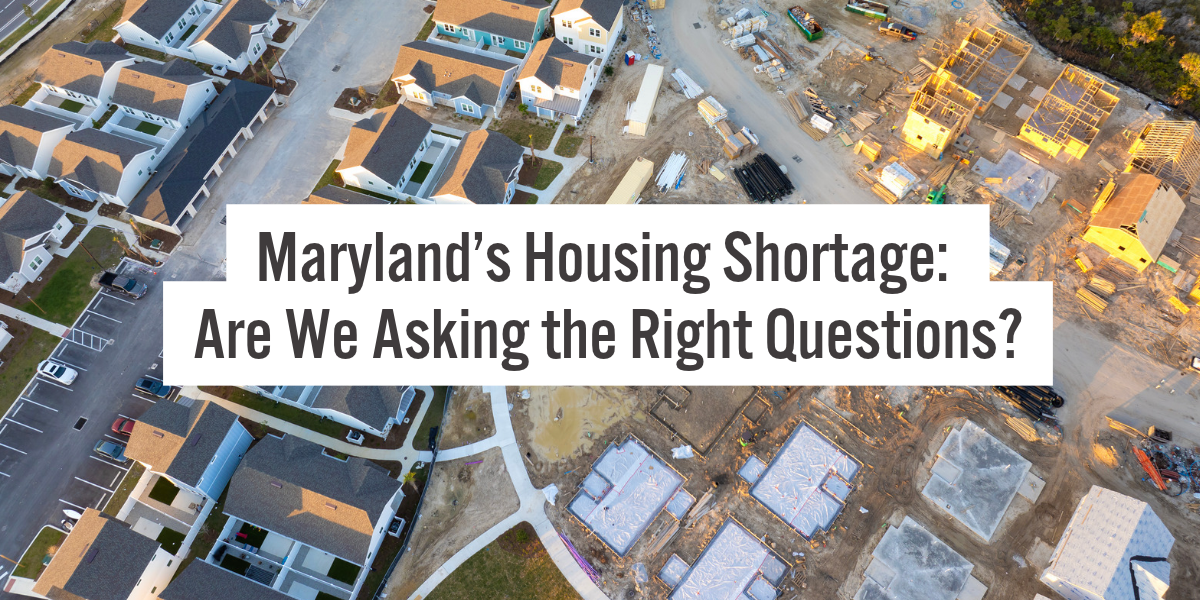
Understanding the numbers, competing priorities, and policy decisions shaping Maryland’s housing market. • Prepared by Tony C, VCRE • September 2026
Maryland’s housing shortage has become a central issue for elected officials, real estate professionals, developers, and residents alike.
One figure consistently leads the conversation: Maryland needs approximately 100,000 additional housing units.
The number has been widely referenced in policy discussions, industry reports, and legislative initiatives aimed at increasing housing production. It has also helped build support for changes to zoning, permitting, and development regulations.
But while there is broad agreement that housing affordability and availability are serious challenges, there is considerably less agreement about how to address them.
How much housing does Maryland actually need? Where should it be built? And are the interests of policymakers, developers, real estate professionals, and residents aligned?
These questions deserve a closer look, particularly as new legislation begins reshaping development opportunities across the state.
Understanding the Numbers Behind the Housing Shortage
Maryland’s housing market faces measurable challenges.
Limited inventory, rising home prices, and barriers to new construction continue to put pressure on buyers and renters. Housing production has struggled to keep pace with demand in many communities, particularly where employment opportunities and infrastructure attract residents.
However, not every housing shortage estimate measures the same thing.
The widely cited estimate of approximately 100,000 units originates with Up for Growth, a national organization focused on housing policy and production. Its methodology considers latent demand, including households that may form if more housing becomes available or affordable.
A December 2025 Maryland Matters investigation examined how the widely cited estimate was calculated and why its interpretation matters in housing policy discussions.
Other research approaches the issue differently.
Maryland’s housing shortage has been measured in several ways, using different methodologies, timeframes, and definitions of need.
| Estimated Units | Source | What It Measures | Timeframe |
|---|---|---|---|
| ~94,000–100,000 | Up for Growth | Estimated housing underproduction based on latent demand | Current estimate |
| 590,186 | DHCD / UMD Smart Growth Center | Zoning-capacity model (Nelson, 2004) | By 2045 |
| 275,000 | DHCD 2025 Needs Assessment | Affordable-rental gap, ≤80% AMI | Current |
| 85,000 | DHCD 2021 study | Gap analysis, <30% AMI | 2021 baseline |
These figures are not necessarily contradictory. They reflect different approaches to measuring housing needs, and each provides a different perspective on Maryland’s housing challenges.
The distinction matters. A statewide estimate can help establish the scale of a challenge, but local development decisions require a more detailed understanding of demand, affordability, infrastructure, and market conditions.
For property owners, investors, and developers, knowing what a number measures is just as important as knowing the number itself.
Different Stakeholders, Different Priorities
Housing policy brings together groups that often share broad objectives but approach them from different perspectives.
Real estate professionals want a functioning market where buyers and sellers can complete transactions.
Homebuilders and developers need predictable approval processes, reasonable development costs, and sufficient demand to support new projects.
Elected officials must balance housing affordability, economic development, infrastructure investment, environmental protection, and constituent concerns.
Residents want access to housing that meets their needs while preserving the characteristics and resources of their communities.
These interests can overlap without being identical.
For example, increasing housing production may help address supply constraints, but it can also raise questions about school capacity, transportation, public utilities, farmland preservation, and the appropriate location of new development.
Similarly, regulatory changes that improve the feasibility of a project do not automatically resolve questions about affordability or community impact.
Recognizing these different priorities is essential to developing housing policies that are both economically practical and responsive to local conditions.
What Do Maryland Residents Actually Support?
Public opinion reflects many of these competing priorities.
Surveys conducted in Maryland have consistently identified housing affordability as a significant concern.
A January 2026 statewide poll commissioned by Greater Greater Washington reported that 92% of respondents considered housing costs a problem.
Recent polling illustrates the difference between recognizing a housing affordability problem and agreeing on how development should proceed.
| Poll | Sponsor | Costs a Problem | On Building |
|---|---|---|---|
| Statewide, Jan. 2026 | Greater Greater Washington / YouGov Blue | 92% (62% “major”) | 58–80% support, in the abstract |
| Montgomery Co., 2025/26 | Baltimore Banner / OpinionWorks | 80%+ | Only ~33% say too slow; 47% oppose Ag Reserve use |
The findings suggest that residents recognize the need to address housing affordability, but opinions become more divided when discussions turn to specific development proposals, density, and land-use decisions.
This distinction is important.
Residents may support additional housing while also expressing legitimate concerns about traffic, infrastructure, environmental resources, and neighborhood compatibility.
The challenge for policymakers is not simply determining whether more housing is needed. It is determining where additional housing makes sense, what type of housing is appropriate, and how communities can accommodate growth responsibly.
Population Trends Add Another Layer to the Conversation
Housing demand is influenced by more than the number of people living in a state.
Maryland has experienced substantial domestic out-migration in recent years, with residents relocating to states such as Pennsylvania, North Carolina, Florida, and Texas.
Housing costs, taxes, employment opportunities, and overall affordability can influence those decisions.
At the same time, international migration, natural population change, household formation, and regional employment patterns can create housing demand even when domestic migration is negative.
A young adult moving out of a family home, for example, creates demand for an additional housing unit without increasing the state’s population.
Likewise, housing needs can vary significantly between communities experiencing employment growth and those facing slower economic activity.
These dynamics complicate the relationship between population trends and housing shortages.
For developers and investors, the more useful question is often not whether Maryland as a whole is growing or shrinking.
It is which local markets are experiencing demand, what types of housing are needed, and whether the economics support new development.
A statewide shortage estimate cannot answer those questions on its own.
The Role of Zoning and Development Regulations
Regardless of which housing shortage estimate is used, Maryland’s development process presents real challenges.
Land development requires navigating zoning requirements, environmental regulations, infrastructure capacity, public review, and multiple stages of permitting.
These processes serve important purposes, including protecting natural resources and ensuring that new construction meets community standards.
However, lengthy approval timelines and regulatory uncertainty can also increase development costs and affect whether a project is financially feasible.
For developers, time carries a measurable cost.
Financing, engineering, land acquisition, construction materials, and carrying expenses can all be affected by delays.
Those costs ultimately influence the price at which new housing can be delivered.
Finding the appropriate balance between regulatory oversight and a predictable development process remains one of Maryland’s most significant housing policy challenges.
How Maryland’s 2026 Housing Legislation Changes the Conversation
Maryland’s 2026 legislative session introduced several measures intended to address barriers to housing production.
Among the major initiatives discussed are:
- Housing Certainty Act: Establishes greater predictability in aspects of the development review process, including application requirements and certain approval protections.
- Transit & Housing Opportunity Act: Seeks to expand housing opportunities in transit-served areas and reconsider development requirements that may limit project feasibility.
- Starter and Silver Homes Act: Addresses opportunities for smaller homes and alternative residential development patterns, while raising questions about the relationship between state housing objectives and local zoning authority.
These initiatives reflect an effort to increase housing production and reduce some of the obstacles associated with development.
They also highlight a longstanding debate over the appropriate division of responsibility between state and local governments.
Statewide policies can establish broad housing objectives, but implementation occurs in communities with different infrastructure capacities, land-use priorities, and market conditions.
For property owners and developers, understanding how these changes interact with existing local regulations will be critical.
A change in state law does not necessarily mean every parcel becomes suitable or eligible for a particular type of development.
Zoning, utilities, access, environmental constraints, and other site-specific considerations remain central to evaluating a property’s potential.
Housing Policy Is Also an Economic Development Issue
Maryland’s housing discussion is taking place within a broader economic environment.
Changes in federal employment, business investment, household income, and migration patterns can all influence real estate demand.
Housing affordability also plays a role in workforce recruitment and retention.
When employees cannot find housing within a reasonable distance of their jobs, employers may face greater challenges attracting and retaining talent.
At the same time, communities need sufficient infrastructure and economic activity to support additional residential development.
These relationships reinforce an important point:
Housing policy cannot be evaluated independently of economic development, employment trends, transportation, and long-term land-use planning.
For commercial real estate professionals, those connections are particularly relevant.
Residential growth can influence demand for retail, medical offices, professional services, industrial facilities, and other commercial uses.
Likewise, major employment changes can affect where housing demand emerges and which development opportunities remain viable.
Moving Beyond a Single Number
Maryland’s housing challenges are real, but a single statewide shortage estimate cannot fully explain them.
The more productive conversation requires examining several questions:
- What types of housing are most needed, and in which markets?
- How do population and employment trends affect local demand?
- Which development regulations create unnecessary delays, and which provide important protections?
- How can infrastructure investment keep pace with growth?
- What role should state and local governments play in determining development patterns?
- How can housing production increase without overlooking long-term community and economic considerations?
These questions do not always have simple answers.
And the answers may look very different in Frederick County than they do in Montgomery County, Baltimore, or other parts of Maryland.
The Bottom Line: Responsible Growth Requires Better Questions
The discussion surrounding Maryland’s housing shortage should not be reduced to whether the state needs more housing.
It should also consider what kind of housing is needed, where development is appropriate, and how policy decisions affect the people and communities involved.
Realtors, builders, elected officials, and residents may agree that affordability is a challenge while holding different views about the best solutions.
That does not make those perspectives incompatible. It makes informed discussion and careful planning even more important.
For landowners, investors, and developers, the implications are practical. Changes in housing policy, zoning, and market demand can influence property values, development feasibility, and long-term investment opportunities.
At Verità Commercial Real Estate, we believe successful real estate decisions begin with understanding the market, the regulatory environment, and the long-term potential of a property.
As Maryland continues to evaluate its housing needs and development policies, those considerations will remain essential to making informed decisions about land use and growth.
The goal should not simply be more development.
It should be development that makes economic sense, responds to demonstrated demand, and contributes to the long-term strength of Maryland’s communities.
Selected Sources
Maryland Matters, “Maryland housing inventory down, prices up, report says,” June 18, 2026;
Maryland Matters, “How many is 96,000? Key housing number cited by Moore is hard to explain,” Dec. 25, 2025;
Mercatus Center, “How to Streamline Housing Permitting in Maryland”; Maryland DHCD / Univ. of Maryland National Center for Smart Growth, “2025 State Housing Needs Assessment,” July 2025;
Up for Growth, Housing Underproduction Report (upforgrowth.org); Maryland Comptroller, “Report on Housing and the Economy,” Oct. 16, 2025;
Greater Greater Greater Washington / YouGov Blue statewide poll, Jan. 2026; The Baltimore Banner / OpinionWorks, Montgomery County housing poll, 2025–26; Maryland Matters, “High housing costs are driving people out of Maryland,” Oct. 21, 2025; M
aryland Matters, “Federal worker layoffs threaten cornerstone industry for Maryland,” June 3, 2026;
Maryland Economic and Fiscal Quarterly Snapshot, Q1 2026 (dashboards.marylandtaxes.gov); Ballard Spahr, “Maryland Housing Certainty Act Signals Changes,” May 2026.


Leave A Comment