
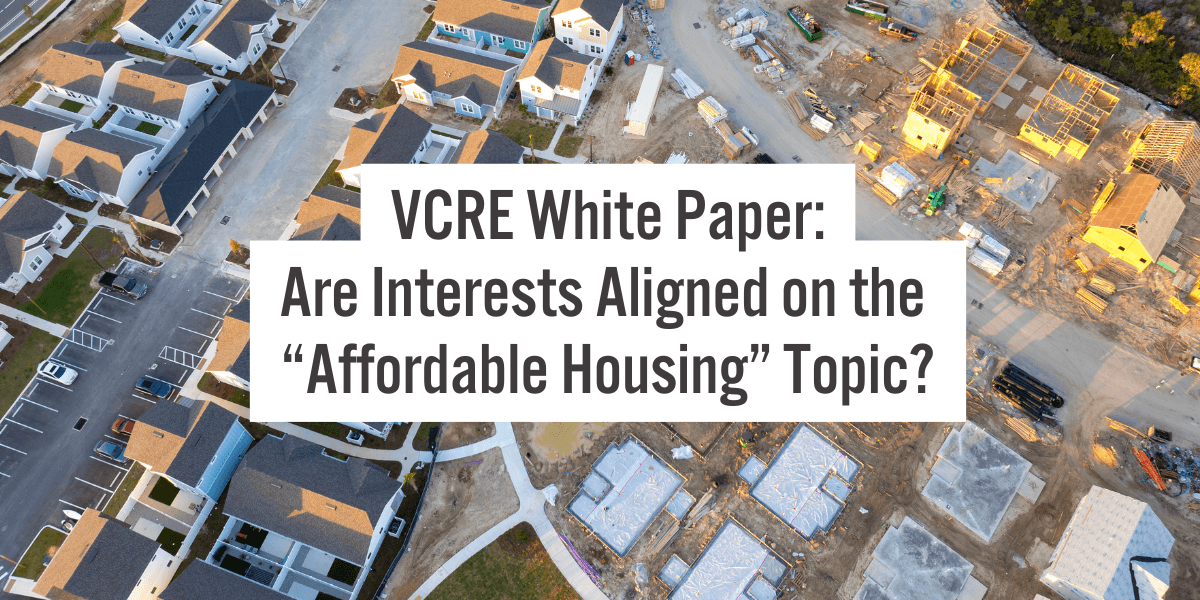
A Maryland case study in who cites the housing-shortage number, who benefits from it, and what the underlying data actually show • Prepared by VCRE • September 2026
Executive Summary
Every stakeholder in Maryland’s housing debate — the Governor’s office, realtor associations, homebuilders, tenant advocates, and county officials — agrees on one sentence: Maryland has a housing shortage of roughly 100,000 units. That consensus has justified an executive order, three 2026 laws preempting local zoning, and an industry sales narrative used to encourage transaction volume. But the number was not produced by a neutral referee, and the agreement it commands fractures the moment you ask what should actually be built, where, and for whom.
This paper traces the widely cited shortage figure to its source, examines who has a financial or political interest in it being large, tests it against independent polling and migration data, and asks the question that matters more than the headline number: are the interests in the room — realtors, builders, elected officials, and residents — actually pointed in the same direction, or merely reciting the same statistic for different reasons?
1. The Number Everyone Repeats
Maryland’s market is genuinely tight: active listings fell 16.4% year-over-year (18,402 to 15,395), new listings dropped 22.1%, and the average sale price still rose 4.7% to $547,405 even as national prices fell for seven straight months. Housing stock grows only ~0.36% annually — by DHCD’s own estimate, half to two-thirds of the needed pace — with roughly 9,000 units lost yearly to demolition against ~18,000 new permits issued, a near wash. Layered on that data is a specific, ubiquitous figure: a “nearly 100,000-unit” shortage. A close variant (96,000, later revised by its source to 94,000) is one Governor Moore has used in “nearly every speech, proclamation and press release” on housing since 2023.
2. Where “100,000” Actually Comes From
That number was not calculated by DHCD, the Comptroller, or any Maryland agency. It originates with Up for Growth, a national advocacy nonprofit, via a “latent demand” model comparing existing housing stock to suppressed household formation — adult children who can’t move out, renters doubling up — not a permit count, vacancy survey, or homelessness census. Maryland’s own commissioned research uses a different, peer-reviewed methodology and reaches a very different number: DHCD’s 2025 State Housing Needs Assessment (University of Maryland’s National Center for Smart Growth) projects 590,186 units needed by 2045, using zoning-capacity and household-projection modeling. A 2021 DHCD study separately found an 85,000-unit gap for households under 30% of area median income, and the 2025 assessment found a 275,000-unit affordable-rental gap. A December 2025 Maryland Matters investigation found officials repeating the 96,000 figure without being able to explain its derivation.
| ~94,000–100,000 | Up for Growth (advocacy nonprofit) | Latent-demand model | Current |
| 590,186 | DHCD / UMD Smart Growth Center | Zoning-capacity model (Nelson, 2004) | By 2045 |
| 275,000 | DHCD 2025 Needs Assessment | Affordable-rental gap, ≤80% AMI | Current |
| 85,000 | DHCD 2021 study | Gap analysis, <30% AMI | 2021 baseline |
3. Follow the Incentives
None of this makes the affordability crisis fake — DHCD/UMD’s research is independently reviewed. But the specific number dominating speeches and headlines is repeated by parties who each benefit from it staying large and unchallenged.
Up for Growth and the advocacy ecosystem
Up for Growth lists the National Association of Realtors among its partner organizations and sits within a broader network of pro-development advocacy groups typically funded by real estate, homebuilding, and lending-adjacent interests. That does not invalidate its research, but the organization producing Maryland’s most-cited number is an advocate for more housing production, not a disinterested statistical agency.
Realtors, builders, and elected officials
Maryland Realtors’ own report is where the “100,000” figure appears in industry form; realtors earn commission on transaction volume, and homebuilders benefit directly from reforms that ease permitting and preempt restrictive local zoning. Governor Moore has built his legislative agenda around the figure, and officials citing DHCD’s own work have generally reached for the larger advocacy number over the agency’s peer-reviewed projection — a state government that benefits politically from an urgent-sounding number is not the same thing as an independent auditor of it.
Pollsters and their clients
Even the poll most cited to show public support for pro-housing bills was commissioned by Greater Greater Washington, a pro-density advocacy group, from YouGov Blue, a firm that surveys primarily for Democratic-leaning clients. YouGov’s execution is professionally credible; the client selected the questions and framing. That is advocacy research, not a neutral public-opinion baseline.
A shortage narrative serves realtors, builders, and elected officials simultaneously and for different reasons — exactly why it has been so durable, and why it deserves more scrutiny than it has received.
4. Do Marylanders Actually Want More Housing?
Marylanders broadly agree costs are a problem: 92% statewide (in the advocacy-commissioned poll) and 80%+ in Montgomery County (a more neutral, news-org-sponsored poll). But agreement on the diagnosis doesn’t carry to the remedy — only ~33% of Montgomery County residents think growth has been too slow, 47% oppose developing the Agricultural Reserve, and opinion splits on multifamily zoning. Organized testimony opposed the Starter and Silver Homes Act specifically for preempting local zoning, and several county officials have pushed back on the 2026 session being framed as the state “limiting local zoning authority.” As one pollster put it, residents want “growth in a certain way,” not “growth at all costs.”
| Poll | Sponsor | Costs a Problem | On Building |
|---|---|---|---|
| Statewide, Jan. 2026 | Greater Greater Washington / YouGov Blue | 92% (62% “major”) | 58–80% support, in the abstract |
| Montgomery Co., 2025/26 | Baltimore Banner / OpinionWorks | 80%+ | Only ~33% say too slow; 47% oppose Ag Reserve use |
5. Who Is Actually Driving Demand?
Maryland is not a population-growth state — it is a net population loser. Roughly 2.3 million residents left for other states between 2010–2023 (net ~40,000/year), led by Florida, Pennsylvania, North Carolina, and Texas, explicitly for cheaper, more plentiful housing. Population held roughly stable only because ~2 million moved in, including substantial international immigration, plus natural increase. Since the pandemic, younger and lower-income households — not just retirees — are increasingly among those leaving, taking $10.2 billion in aggregate income out in 2022 alone against $7.5 billion brought in. Pressure on existing stock looks less like population growth and more like suppressed household formation colliding with flat supply and pockets of transit- and job-driven in-migration. This paper found no reliable Maryland-specific data on institutional-investor purchase share and does not assign it a demand weight.
6. The Regulatory Drag on Supply
Independent of the headline number, the friction is real and documented: developers typically wait three to four years between securing land and receiving an occupancy permit, and each added month of delay adds roughly $4,400 (about 1%) to building cost. Drivers include low-density zoning, agricultural/forest preservation rules, and overlapping environmental reviews administered inconsistently by jurisdiction; nine counties require community input meetings even for by-right subdivisions. The state does not systematically track proposals submitted versus approved, so most delay evidence remains anecdotal rather than statistical.
7. The 2026 Legislative Response
- Housing Certainty Act (eff. Oct. 1, 2026): locks in rules at application filing, 30-day completeness review, 5-year vesting, delays impact-fee collection until occupancy.
- Transit & Housing Opportunity Act: eliminates transit-area parking minimums; targets ~7,000 units and $1.4B in revenue from 300+ state-owned acres.
- Starter and Silver Homes Act: allows smaller lots/homes and by-right townhouses statewide; drew the most organized local zoning-preemption opposition.
- Housing Starts Here executive order (2025): first jurisdiction-by-jurisdiction production targets, aiming to nearly double annual permitting from ~18,000 to 39,041 units by 2030.
8. The Economic Backdrop
This is unfolding alongside a labor shock. Maryland’s GDP grew ~4% in 2025 to $568B, driven by high-tech productivity and real estate itself — but employment moved the opposite direction. Unemployment rose from 3.6% to 4.3%, and the state lost 49,900 jobs year-over-year through March 2026 — the largest decline of any U.S. state, roughly half of it from federal downsizing (an estimated 29,000–31,000 federal jobs cut in a state that still employs close to 230,000 federal workers). That forced closure of a budget gap over $1 billion this legislative session, and it is accelerating the same cost-driven out-migration reshaping housing demand described in Section 5.
Conclusion: Are Interests Aligned?
Partially, and unevenly — which is a more useful answer than either “yes” or “no.” Realtors, builders, and elected officials are genuinely aligned on wanting the shortage narrative to hold: it supports transaction volume, lowers development cost and risk, and provides political cover for an ambitious legislative agenda. Residents are aligned with them on the diagnosis — costs are too high, across every demographic and geographic line polled — but far less aligned on the remedy, favoring negotiated, managed growth over blanket rezoning near their own homes.
The “100,000-unit shortage” is less a verified state fact than a widely adopted advocacy estimate that happens to serve nearly every interest in the room simultaneously — which is exactly why it survives scrutiny so easily. The more defensible pattern: Maryland is losing residents faster than it is losing housing units, the residents most likely to buy starter homes are increasingly among those leaving, permitting friction is real independent of any shortage figure, and 2026’s reforms address that friction without resolving the underlying zoning disagreement. A room of realtors, builders, and elected officials can agree on “we need more housing” and still be operating from materially different incentives about what that sentence should mean in practice.
“Given that Maryland is a net population loser to out-migration, not a growth state — what is your office’s confidence in the roughly 100,000-unit shortage figure, and what do you see as the real driver of housing demand here: growth, or people who can no longer afford to stay?”
A candid answer to that question does more to align the room’s interests than another repetition of the number itself.
The Bottom Line for This Room
- For realtors and builders: the figure that best sells urgency to a buyer or a legislature is not the figure a planner would use to size a zoning map — know which one you’re citing, and to whom.
- For elected officials: independent verification of the shortage figure would strengthen the case for reform, not weaken it — a number that survives scrutiny is more durable than one that doesn’t.
- For everyone in the room: the 2026 reforms target permitting friction that is real and well documented. They do not resolve the deeper disagreement over where density belongs — that conversation still has to happen locally, block by block.
Selected Sources
Maryland Matters, “Maryland housing inventory down, prices up, report says,” June 18, 2026; Maryland Matters, “How many is 96,000? Key housing number cited by Moore is hard to explain,” Dec. 25, 2025; Mercatus Center, “How to Streamline Housing Permitting in Maryland”; Maryland DHCD / Univ. of Maryland National Center for Smart Growth, “2025 State Housing Needs Assessment,” July 2025; Up for Growth, Housing Underproduction Report (upforgrowth.org); Maryland Comptroller, “Report on Housing and the Economy,” Oct. 16, 2025; Greater Greater Washington / YouGov Blue statewide poll, Jan. 2026; The Baltimore Banner / OpinionWorks, Montgomery County housing poll, 2025–26; Maryland Matters, “High housing costs are driving people out of Maryland,” Oct. 21, 2025; Maryland Matters, “Federal worker layoffs threaten cornerstone industry for Maryland,” June 3, 2026; Maryland Economic and Fiscal Quarterly Snapshot, Q1 2026 (dashboards.marylandtaxes.gov); Ballard Spahr, “Maryland Housing Certainty Act Signals Changes,” May 2026.


Leave A Comment