
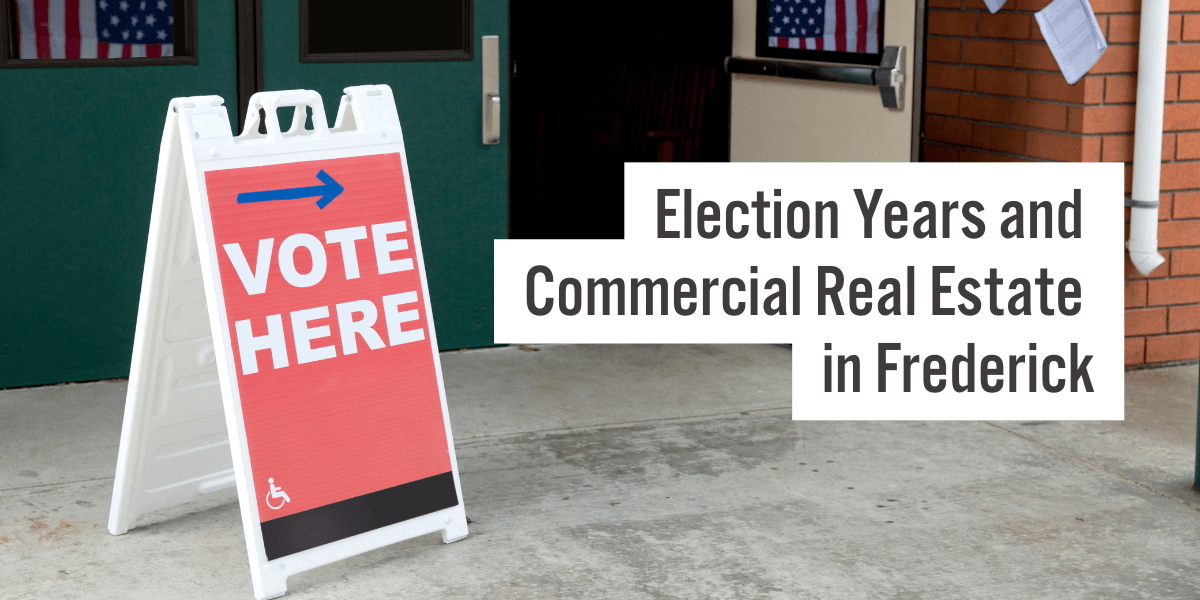
Election years bring a lot of noise. Headlines change by the day. Businesses hear competing ideas about taxes, interest rates, development, regulations, and the economy.
For business owners, commercial real estate investors, and property owners, that uncertainty can make a big decision feel even bigger.
Should you buy now or wait? Is this the right time to sell? Should you renew a lease or look for another location? Will financing conditions change?
There is no single answer. But there is one important principle: an election does not automatically change the fundamentals of a good commercial real estate decision.
Understanding what can affect your property—and what is simply noise—can help you make a more informed decision.
Why Election Years Create Commercial Real Estate Uncertainty
Research has found that economic uncertainty can rise around a close election, and that uncertainty may cause some businesses to delay investments.
That does not mean commercial real estate activity stops.
It means some buyers, sellers, tenants, lenders, and business owners may become more cautious. An investor may spend more time analyzing a purchase. A business may delay an expansion. A property owner may wonder if waiting six months will produce a better opportunity.
Sometimes waiting makes sense. But waiting can also have costs.
The key is separating known property facts from unknown political outcomes.
Interest Rates Matter, But Elections Do Not Set Them
Interest rates have a major impact on commercial real estate.
Higher borrowing costs can change an investor’s expected return. They can affect how much a business can afford to pay for a property. They can also influence development costs, refinancing decisions, and property values.
However, elections do not directly determine Federal Reserve interest-rate decisions. The Federal Reserve conducts monetary policy based on its statutory goals and economic conditions.
Instead of trying to predict future rates, investors and business owners can ask:
- What financing is available today?
- What does this property look like at different interest rates?
- Does the property generate adequate cash flow?
- When does existing debt mature?
- What happens if refinancing costs change?
Those questions are valuable in an election year—or any year.
Local Factors Can Matter More Than National Headlines
Commercial real estate is local.
A national political story may dominate the news while a zoning change, road improvement, new employer, development project, or shift in local supply has a much greater effect on a specific Frederick County property.
That is why local knowledge matters.
Frederick County continues to plan for employment growth, infrastructure, economic development, and land available for commercial uses. Property owners should pay attention to local planning and zoning decisions because they can directly affect how property may be used.
Before making a decision, consider:
- What is the property’s current zoning?
- What uses are permitted?
- What development is planned nearby?
- How strong is tenant or buyer demand?
- What competing properties are available?
- Are infrastructure changes planned?
- What are current rents, vacancies, and comparable sales?
Those facts can provide much more useful information than trying to predict what will happen after Election Day.
Business Owners Should Keep the Business First
For a business owner, commercial real estate should support the business—not distract from it.
Election-year uncertainty may make signing a long lease or buying a building feel risky. But delaying a move can have consequences, too.
Maybe your current location is too small. Perhaps parking is hurting your business. Your lease may be approaching expiration. Or you may need a different location to reach customers, add employees, or grow.
Instead of asking, “What will happen after the election?” start with:
“What does my business need from its real estate over the next three, five, or ten years?”
That shifts the conversation from speculation to planning.
Investors Should Stress-Test the Deal
Investors naturally pay attention to uncertainty. Returns, taxes, financing, occupancy, and timing can all affect a commercial real estate investment. These are also among the major concerns VCRE hears from investors.
An election adds another unknown, but it should not replace careful analysis.
Consider several scenarios before buying.
What happens if borrowing costs remain elevated? What happens if a tenant leaves? Can the property support unexpected repairs? Is there an opportunity to improve occupancy or rents? How long are you prepared to hold the asset?
A strong investment strategy should work under more than one possible future.
Property Owners Should Know Their Options
Property owners may face a different question: Is now the right time to sell?
For someone who has owned land or commercial property for many years, the decision may involve much more than price. Taxes, family goals, retirement, timing, development potential, and the terms of a sale may all matter. These concerns align closely with what VCRE sees among landowners navigating a potential transaction.
Election-year uncertainty can make it tempting to wait for more clarity.
Before doing that, understand what you own and what the market may currently offer. A knowledgeable commercial real estate professional can help you examine zoning, potential uses, comparable transactions, buyer demand, timing, and possible deal structures.
You do not need to predict an election to start gathering good information.
Know What Is on Your Local Ballot
Commercial real estate is local, and many government decisions that affect property owners and businesses happen close to home.
Land use, development, infrastructure, permitting, taxes, and other policies can be shaped at the county and state levels.
Maryland voters can visit the Maryland State Board of Elections to find 2026 election information, important dates, candidates, and certified ballots.
Frederick County residents can also use the Frederick County Board of Elections for local voting and election information.
Want to know what will appear on the ballot for your address? Maryland’s Voter Lookup allows registered voters to check their registration, voting districts, polling information, and sample ballot.
These official resources are a good place to start before researching individual candidates and issues.
Research Issues That Affect Real Estate and Business
Industry organizations can provide another perspective on public policy affecting real estate, housing, development, and businesses.
The National Association of REALTORS® Political Action Committee (RPAC) supports candidates it determines will advance REALTOR® and real estate industry interests. Because RPAC is an advocacy organization, its information represents an industry perspective rather than a nonpartisan voter guide.
The National Association of Home Builders’ Vote for Housing initiative provides information about housing policy and encourages voters to research candidates’ positions on housing issues.
NAHB also operates BUILD-PAC, its bipartisan political action committee, which supports federal candidates based on NAHB’s housing and business policy priorities.
For another source of election information, voters can explore the League of Women Voters’ VOTE411. VOTE411 provides personalized voting information, including candidate information where available.
When researching candidates, business owners, investors, and property owners may want to understand their documented positions on issues such as:
- Land use and zoning
- Commercial and residential development
- Business taxes and fees
- Infrastructure investment
- Permitting and development review
- Housing supply
- Economic development
- Transportation
- Property rights
These resources provide different perspectives. Voters should review candidates, issues, and original sources and make their own decisions.
Focus on Facts, Not Forecasts
No broker, investor, economist, or political expert can guarantee what commercial real estate markets will do after an election.
That is why a sound real estate strategy should not depend on one political outcome.
Instead, focus on what you can evaluate:
- Your financial position
- Current financing options
- Property fundamentals
- Lease or sale terms
- Local supply and demand
- Zoning and land-use considerations
- Your timeline and long-term goals
Good decisions begin with good information.
Make Your Next Commercial Real Estate Decision With Confidence
Election years can create uncertainty, but commercial real estate decisions rarely happen in a vacuum.
Businesses still grow. Leases expire. Investors find opportunities. Owners retire. Properties change hands.
The goal is not to ignore uncertainty. It is to understand which risks actually matter to your property, your business, and your plans.
At VCRE, we help business owners, investors, and property owners understand the Frederick-area commercial real estate market and evaluate their options. Our team brings local knowledge, experience, responsive communication, and a practical approach to each transaction.
Whether you are considering buying, selling, leasing, investing, or simply trying to understand your options, a conversation today can help you prepare for tomorrow.
Contact VCRE to discuss your commercial real estate goals and build a strategy based on your property, your timeline, and the local market—not the political headlines.



Leave A Comment